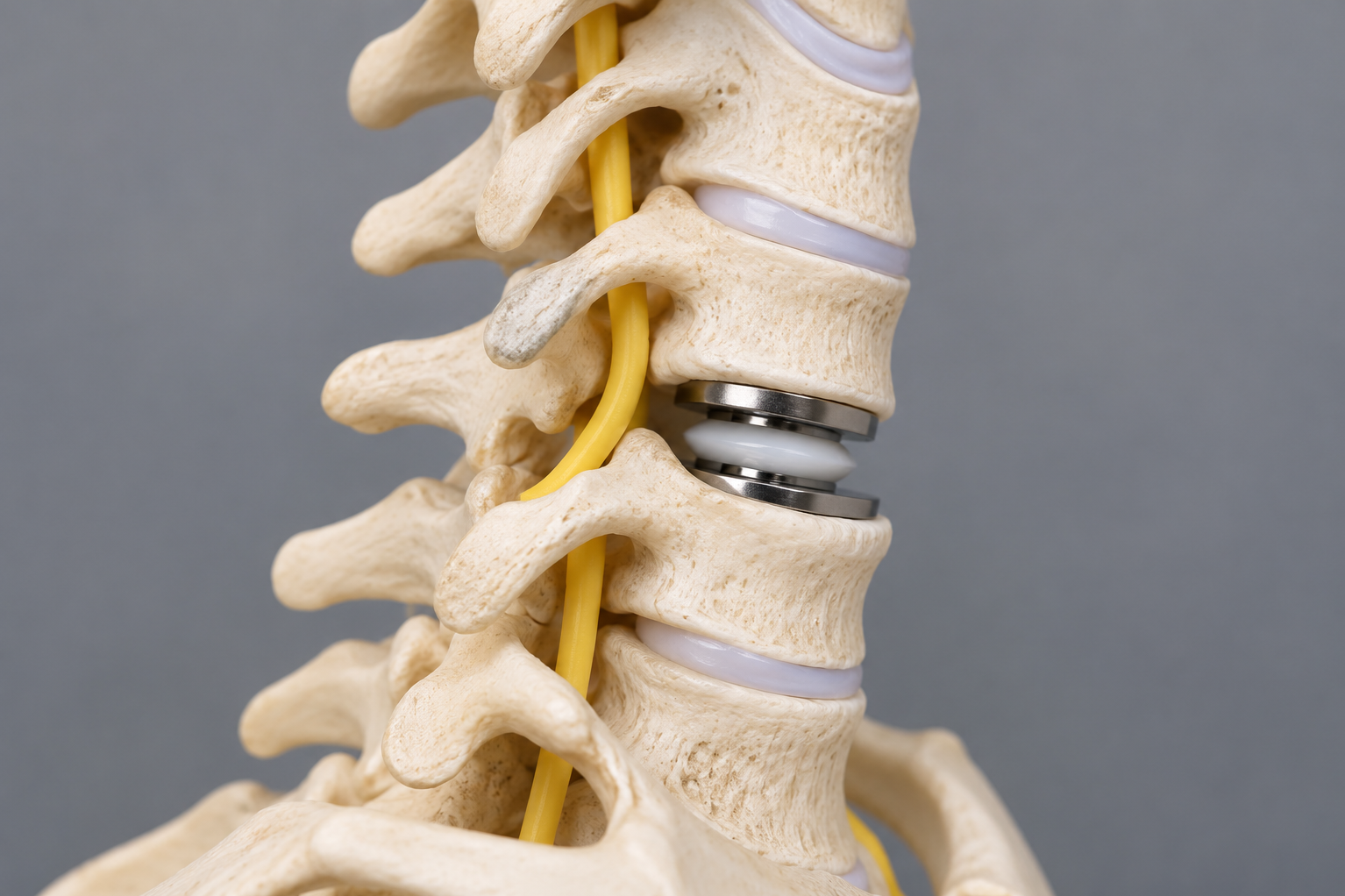
Cervical Disc Replacement is a surgical procedure designed to remove a damaged cervical disc and replace it with an artificial implant while preserving movement at the treated spinal level.
It may be considered for selected patients experiencing nerve compression caused by cervical disc disease.
However, not every patient with neck pain, disc degeneration, or arm symptoms is a suitable candidate.
Understanding eligibility is essential before comparing Cervical Disc Replacement with other surgical approaches.
When Cervical Disc Replacement May Be Considered
The procedure is most commonly evaluated when cervical disc disease causes persistent nerve-related symptoms that have not responded adequately to appropriate conservative treatment.
Symptoms may include:
- Neck pain with radiating arm pain
- Tingling in the fingers
- Arm numbness
- Muscle weakness
- Reduced daily function
Some carefully selected patients with spinal cord compression may also be considered, depending on the condition and implant indications.
Clinical findings must correspond with imaging abnormalities.
How Cervical Disc Replacement Differs From Fusion
Both cervical disc replacement and anterior cervical fusion involve removing the problematic disc and decompressing affected neurological structures.
The main difference concerns movement at the operated level.
Fusion aims to join adjacent vertebrae permanently.
Disc replacement uses an artificial implant intended to preserve motion.
Motion preservation may offer advantages for suitable patients, but it does not eliminate the possibility of future degeneration or additional surgery.
The choice depends on anatomy, spinal stability, bone quality, and the number of affected levels.
Who May Not Be Suitable for Disc Replacement
Certain conditions can make artificial disc replacement inappropriate.
These may include:
- Significant spinal instability
- Severe facet joint arthritis
- Marked osteoporosis
- Certain spinal deformities
- Active infection
- Severe structural degeneration
- Anatomy unsuitable for the selected implant
Eligibility also depends on implant-specific indications and regulatory approvals.
Patients should not assume that a newer or motion-preserving procedure is automatically preferable.
What Happens During the Procedure
Cervical Disc Replacement is usually performed through an incision at the front of the neck.
The surgeon carefully reaches the affected disc, removes damaged material, and decompresses the relevant nerve structures.
An appropriately sized artificial disc is then positioned between the vertebrae.
Imaging may be used during surgery to confirm implant placement.
The procedure is performed under general anaesthesia.
Recovery and Expected Benefits
Many patients begin gentle mobilisation soon after surgery.
The treating surgeon may provide instructions regarding neck movement, wound care, driving, and return to work.
Desk-based activities may resume within a few weeks for some patients, while heavier physical work may require longer.
Potential benefits include relief of nerve-related arm symptoms and preservation of movement at the treated level.
Recovery of neurological weakness or numbness depends partly on the severity and duration of preoperative nerve compression.
Risks Patients Should Understand
Possible complications include infection, bleeding, nerve injury, spinal cord injury, swallowing difficulty, voice changes, implant movement, implant wear, and persistent symptoms.
Abnormal bone formation around the implant can also reduce preserved movement.
Some patients may eventually require further surgery.
Frequently Asked Questions
Is Cervical Disc Replacement suitable for older patients
Age alone does not determine eligibility. Bone quality, degeneration, anatomy, and overall health are important.
How long does an artificial cervical disc last
Implants are designed for long-term use, but individual durability and the possibility of revision surgery cannot be guaranteed.
Does disc replacement completely restore normal neck movement
The procedure aims to preserve movement at the treated level, but it does not guarantee completely normal spinal mechanics.
Patients considering Cervical Disc Replacement in Pune, Maharashtra, can discuss surgical suitability with Dr. Rahul Chaudhari.
A meaningful comparison should focus on neurological findings, anatomical suitability, expected functional outcomes, and long-term risks rather than the appeal of a particular surgical technology.
Keywords